
Understanding the 4 Ps of Marketing and How to Apply Them
Wondering why your product or service isn’t performing as expected? The problem may not be the offer itself. Your Product, Price, Place, and Promotion strategies may not be aligned with customer needs.
Marketing professor E. Jerome McCarthy first proposed the 4 Ps in the 1960s as a simple way to explain a marketing plan’s essential elements. The 4 Ps of marketing are still globally recognized and used as a clear first step for understanding how to position your offering and evaluate what is missing.
Let me explain the 4 Ps of marketing, which will improve your decision-making and help you grow your Return on Investment (ROI). This foundational marketing concept provides clear guidelines to support sales growth.
Table of Contents

Understanding the 4 Ps of Marketing Mix
The 4 Ps of digital marketing are Product, Price, Place, and Promotion. Together, they form a framework for deciding what to sell, how much to charge, where customers can buy it, and how to communicate its value.
The concept originated with Harvard professor James Culliton in 1948. It was originally called the “mix of ingredients,” which marketers used to describe the concept. Professor Neil Borden later popularized the term and developed a comprehensive framework with 12 elements, since the original four Ps were not the only ones.
Borden’s original marketing mix included 12 interconnected elements:
- Product planning
- Pricing
- Branding
- Channels of distribution
- Personal selling
- Advertising
- Promotions
- Packaging
- Displays
- Services
- Physical handling
- Fact-finding analysis
In essence, the marketing mix is a simple way to think about how you bring your product or service to life for your customers. The marketing mix is a strategic framework of controllable elements commonly referred to as the 4 Ps (Product, Price, Place, and Promotion), as simplified by E. Jerome McCarthy.
These 4 Ps of the marketing mix are critical for product or service launches because they support better strategic decision-making.
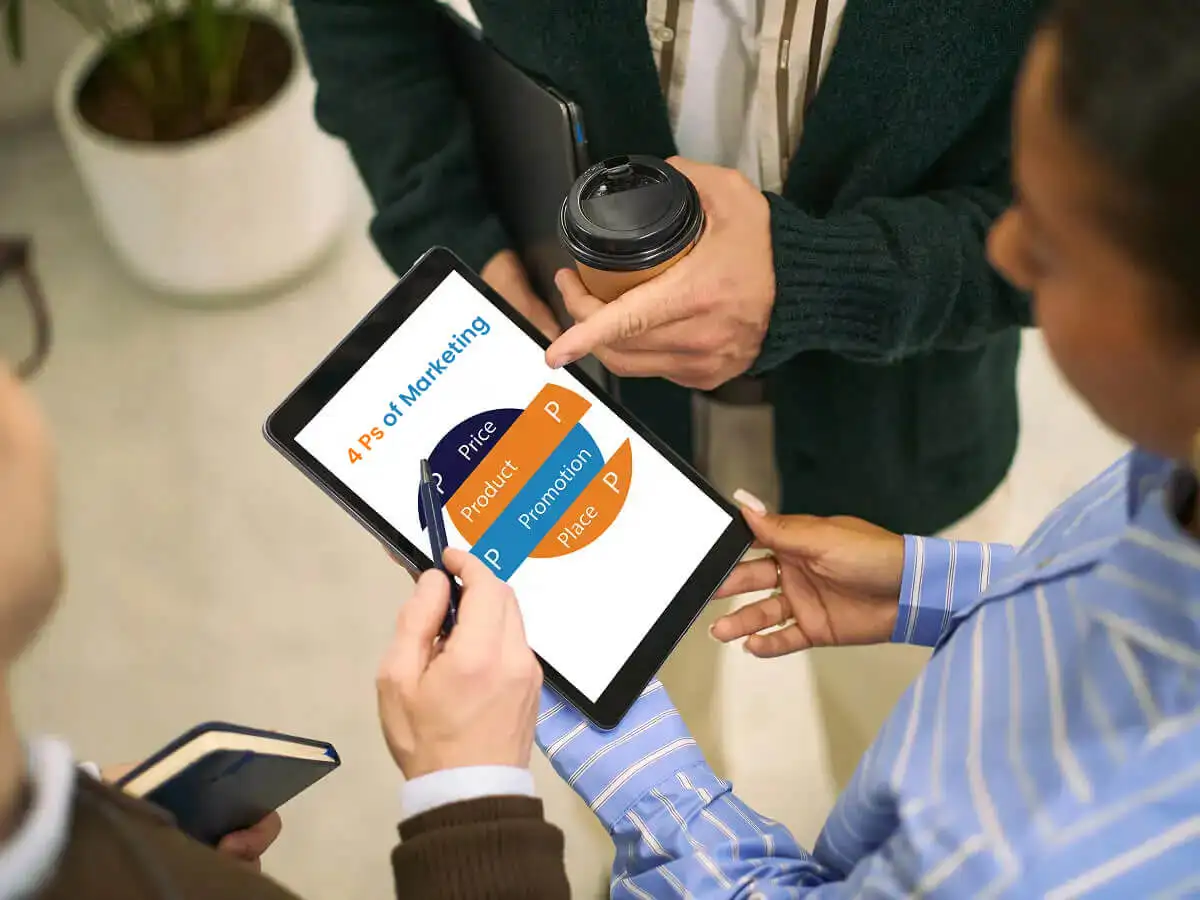
Four Core Elements of the Marketing Mix
The 4 Ps of digital marketing are influenced by four key market forces, which are:
- Consumer buying behavior
- Trade behavior (wholesalers and retailers)
- Competitor positioning and response
- Government regulations
Each of the four elements plays a role in an effective marketing strategy from the marketing mix; therefore, let’s discuss what the 4 Ps of marketing strategy are in detail:

Product: Meeting Customer Needs with the Right Offering
The first and most important P in the marketing mix is ‘Product’. Product is the good or service you market to your target audience.
Product is key to a business’s success, and a successful product solves buyers’ problems or offers a novel experience that creates demand.
According to research done by CB Insights on startup failure causes, there are multiple reasons. Out of those reasons, the study found:
”43% fail due to no market need. Founders build something they love rather than something people pay for.”
One of the most effective ways to develop a good product is to consider potential customers in your segmented audience and their unique needs. Some questions you can consider when working on product development include:
- What is your product?
- What does your product do?
- Does the product meet an unmet need, or does it provide a novel experience?
- Who is your product’s target audience?
- How is your product different from what others offer?
Price: Setting a Competitive and Profitable Price
The second P in the marketing mix is ‘Price’. Price is the cost of your service or product. A successful product must set a price that is both accessible to your target market and aligned with your business goals.
Several pricing models can help you set your product’s price and drive success. Some of the widely acknowledged pricing models are:

- Value-Based Pricing : The value-based pricing model focuses on the value the customer perceives in the product or service rather than production cost. This model is best for luxury items, unique products, and enterprise software.
- Dynamic Pricing : A dynamic pricing model adjusts prices in real time based on time, demand, or competitor activity in the market. Dynamic pricing models work best for ridesharing, hospitality, and travel.
- Penetration Pricing : The penetration pricing model involves launching a product or service at a temporary or lower introductory price to capture market share. Penetration pricing is best for disruptors or new entrants trying to establish their segment.
- Price Skimming : Price skimming is the process of setting a high initial price for a product or service due to its innovation, then lowering it over time. The price skimming model is best for tech gadgets and electronic products.
- Bundle Pricing : The bundle pricing model sets a price for multiple products or services sold together at a lower combined cost. Bundle pricing works best for subscriptions, fast-food meals, and software suites.
To set your product or service price, you must understand your target audience and their purchasing power. Purchasing power refers to how much your target customer can pay for your product or service.
Some questions you might ask yourself as you are considering your product’s price include:
- What is the price range of your product’s competitors?
- What is the price range of your target audience?
- What price is too high for your audience? What price is too low?
- What price best fits your target market?

Place: Making Products Available to Customers
Place refers to where and how customers can access or purchase a product or service. This includes physical stores, ecommerce websites, marketplaces, distribution partners, and other sales channels. Choosing the right distribution approach helps businesses make their offerings accessible to the customers they want to reach.
To decide the best place to market your product or service, consider thorough research into digital channels or physical locations that could help you market it. Some of the questions you could ask before deciding the place are:
- Where will you sell your product?
- Where does your target audience shop?
- What distribution channels are best to reach your target market?
Promotion: Communicating Value to the Target Audience
The 4th P in the marketing mix framework is ‘Promotion’. Promotion refers to how you advertise your service or product. To achieve business goals through a successful service or product marketing campaign, you must promote and generate word of mouth.
Effective promotion helps your target audience understand the product’s value, build confidence in their purchasing decisions, and develop a stronger connection with your brand.
There are multiple ways to promote your product or service. Widely acclaimed promotional methods include word of mouth, print advertisements, and television commercials.
However, in the digital era, other digital promotional methods include content marketing, email marketing, display ads, and social media marketing.

When working on product promotion, some questions you can consider are:
Some questions you might ask yourself as you are considering your product’s price include:
- What is the best time to reach your target audience?
- What marketing channels are most effective for your target audience?
- What marketing messages would most resonate with your target audience?
- What advertising approaches are most persuasive to your target audience?

Real-World 4 Ps of Marketing Examples
For a clearer understanding, let me share 3 real-world examples of the concept of the 4 Ps of marketing:
Apple: iPhone 18 Pro
Apple’s iPhone 18 Pro and Pro Max are its most advanced flagship smartphones, designed for users who want top-tier performance, photography, and premium build quality. They combine a variable-aperture camera system with the A20 Pro chip and iOS 27.
Product: The phones feature a 48MP Fusion Main camera with variable aperture, the A20 Pro chip, and storage options from 256GB to 2TB. They are available in burgundy, glacier, silver, and black.
Price: The iPhone 18 Pro starts at $1,199, or $49.95 per month for 24 months. The Pro Max starts at $1,299, or $54.12 per month for 24 months, $100 more than the previous generation.
Place: Apple sells directly through Apple.com, Apple Stores, and select carriers. Pre-orders began September 12, with US availability on September 18 and availability in 20 additional countries on September 25.
Promotion: Apple offers an estimated $175–$885 trade-in credit for eligible iPhone 13 or newer devices. Apple Card Monthly Installments offer instant trade-in application, while select carriers advertise up to $1,200 in bill credits over 36 months.
Marketing Takeaway: Apple’s approach demonstrates how premium pricing, differentiated product features, controlled distribution, and coordinated launch promotions can reinforce a consistent market position. Businesses should ensure their pricing and promotional messages reflect the value their products deliver.
Starbucks: “Back to Starbucks” / Green Apron Service
Starbucks is a global coffeehouse brand that sells beverages, food, and an in-store experience built around convenience and personalization. Its 2026 Rewards relaunch aims to make loyalty more valuable and engaging for regular customers.
Product: Starbucks’ core offering includes coffee, food, and the Green Apron Service experience. Its “Back to Starbucks” strategy also includes menu innovation, coffeehouse upgrades, and a redesigned Rewards program.
Price: Starbucks uses a differentiated pricing approach based on beverage type, customization, product size, and market location. Its pricing reflects brand positioning, convenience, and customer experience, while loyalty rewards provide additional incentives for repeat purchases.
Place: Starbucks Rewards is available through the Starbucks app across its coffeehouse network. Green Apron Service is embedded in daily operations at company-operated stores.
Promotion: The redesigned program launched March 10, 2026, with Green, Gold, and Reserve tiers. Starbucks also used limited-time menu items and star-earning promotions to drive engagement.
Marketing Takeaway: Starbucks demonstrates how customer experience, loyalty programs, and personalized promotions can work together to encourage repeat purchases. Businesses can apply this principle by connecting their promotional efforts with customer retention rather than focusing exclusively on acquiring new buyers.
Waymo: Robotaxi Ride-Hailing Service
What it is: Waymo is Alphabet’s autonomous ride-hailing service. Riders book a driverless car through the Waymo app or, in Austin and Atlanta, through Uber, and travel without a human driver.
Product: Waymo sells fully autonomous rides, not vehicles. Its service uses the sixth-generation Waymo Driver, including the Ojai robotaxi, which first began carrying riders in Phoenix, Los Angeles, and San Francisco in June 2026 before expanding to additional cities.
Price: Waymo fares are quoted in the app and vary by distance, time, demand, and city. In Las Vegas, Waymo charges a base rate of $9.49 plus $1.23 per mile and $0.45 per minute, with the final fare subject to demand.
Place: Waymo operates within designated service areas in select US cities. Customers can access rides through the Waymo app or, in certain markets, through partner platforms such as Uber. Service availability, booking options, and geographic coverage vary by location.
Promotion: Waymo relies on phased rollouts rather than mass advertising. It typically adds riders gradually through waitlists or invitations, then expands access; in Las Vegas, for example, it began with rolling invitations before adding airport access for existing riders.
Marketing Takeaway: Waymo illustrates how distribution availability can be as important as the product itself. Its phased expansion strategy highlights why businesses should consider market readiness, customer accessibility, and operational capacity before expanding into new locations.

Building a 4 Ps Marketing Strategy That Drives Conversions
There is a risk of applying the 4 Ps of marketing strategy inappropriately, so let me simplify it for you:
Step 1: Start by analyzing the product you’ll market. Why is it appealing? What are its features? And how is it solving a real customer problem? To do this effectively, research similar products from competitors in the market.
Your product might offer a novel experience to your target audience, or it might be easier to use. You should identify how it differs and adds value for the consumer.
Step 2: Now set the appropriate price for your product. The cost includes not only production, but also the profit margin. You can position it as a low-price alternative or as a premium product.
Step 3: For placement, identify the type of store you want online or offline, where the product will be sold, and the channel through which consumers learn about it.
Step 4: The last stage of building a 4 Ps marketing mix that drives conversions is setting the promotional strategy. Tailor the promotional strategy to the target consumer.
The effectiveness of these elements of marketing mix 4 Ps depends on how well they work together. A premium product may struggle if its pricing attracts the wrong audience, its distribution channels limit accessibility, or its promotional message fails to communicate value.
Businesses should evaluate these elements together rather than optimizing each one independently. Reviewing customer feedback, conversion rates, competitor positioning, and sales performance can help identify where adjustments are needed.

Common Marketing Mix Mistakes to Avoid
Modern 4Ps of marketing come with other variations in which there are more elements making it 7 Ps of marketing. The three additional elements added to this 4 Ps framework are people, physical evidence, and process.
7 Ps of Marketing
People are the team or employees who interact with customers. Physical evidence is a tangible environment and visual proof that supports intangible services. Finally, process in the 7 Ps of marketing refers to the support or step-by-step workflow used to deliver a service or product to the customer.
5 Cs of Marketing
5 Cs of Marketing framework includes customer, company, competition, collaborators, and climate, shifting focus and leaning more towards the external forces shaping a marketing strategy.
Related Frequently Asked Questions
The 4 Ps provide a structured framework to properly position an offering, optimize decision-making, and address market gaps. Aligning these four core elements ensures your product reaches the right audience effectively, ultimately driving higher sales and boosting ROI.
While the traditional 4 Ps focus on Product, Price, Place, and Promotion, the 7 Ps extend the model to suit service-oriented businesses better. It incorporates three additional execution-focused elements: People (the team interacting with buyers), Physical Evidence (the tangible brand environment), and Process (the delivery workflow).
Small businesses can apply the 4 Ps by first developing a data-backed product that solves a real customer problem, then setting a price aligned with target market purchasing power. They should then sell through channels where their audience actively shops and focus their promotional budget strictly on platforms their customers use most.
In the digital age, 'Place' has shifted from physical locations to online storefronts and app networks, while 'Price' frequently utilizes dynamic, real-time algorithms. Additionally, 'Promotion' has expanded beyond traditional print and TV to leverage targeted digital channels like content marketing, email, and social media.
Yes, the 4 Ps remain globally recognized and foundational to modern business strategy. Even as digital landscapes evolve, evaluating Product, Price, Place, and Promotion remains essential for analyzing customer demand and preventing costly marketing missteps.
Conclusion
The 4 Ps of marketing – Product, Price, Place, and Promotion – provide a practical framework for understanding customer needs, positioning your offering, and improving your marketing strategy. When these elements work together, businesses can make better decisions about where to invest and how to reach the right audience.
However, understanding the framework is only the beginning. Applying it requires evaluating market demand, customer behavior, competitive positioning, and campaign performance.
Need Help Aligning Your Marketing Strategy With Your Business Goals?
IT Verticals helps businesses develop digital marketing strategies based on their target audience, competitive environment, and growth objectives.
Revision History
Updated publication: Oct 29, 2026
Author: Adam Romy, Fact Checker: Samantha Leonie
Original Publication: Feb 16, 2024
Author: Adam Romy, Fact Checker: Samantha Leonie
Author

Adam Romy
Technology Content Author
Adam Romy is an author at IT Verticals, contributing to content covering technology and digital business topics. His work focuses on presenting information clearly and accurately for business readers. He helps make complex subjects easier to understand and apply.

Adam Romy
Author
Technology Content Author
Adam Romy is an author at IT Verticals, contributing to content covering technology and digital business topics. His work focuses on presenting information clearly and accurately for business readers. He helps make complex subjects easier to understand and apply.
Fact Checker

Samantha Leonie
Author & Fact Checker/Validator
Content Quality & Fact-Checking Specialist
Samantha Leonie is a fact-checker at IT Verticals, reviewing content for accuracy, clarity, and consistency before publication. She helps maintain the quality and reliability of published information.