

AI Development Cost: Complete Breakdown for 2025
In 2025, Artificial intelligence will no longer be a luxury. It’s a major business shift. Whether streamlining operations and optimizing productivity , or personalizing customer experiences and empowering smarter automation, AI xhas ushered in a revolutionary wave in business operations across all sectors. Despite the potential of AI , the first question that all decision makers still have in mind is How Expensive is AI development cost?
We see the wave coming. By this time next year, every company will have to implement it, not just a strategy. Implement it.
Emad Mostaque, Founder and CEO of Stability AI
How much does AI cost? The answer to this is a bit different, actually, a lot. It may vary significantly depending on the complexity of the project, its purpose, the necessary tech stack, the skills of the overall team, and the data. This blog provides you with a detailed overview of the AI development cost in 2025, while discussing industry-related averages, cost-saving strategies, common questions, and estimates so that you can make an informed decision.
Table of Contents
How Much Does AI Cost Based on Project Type and Complexity
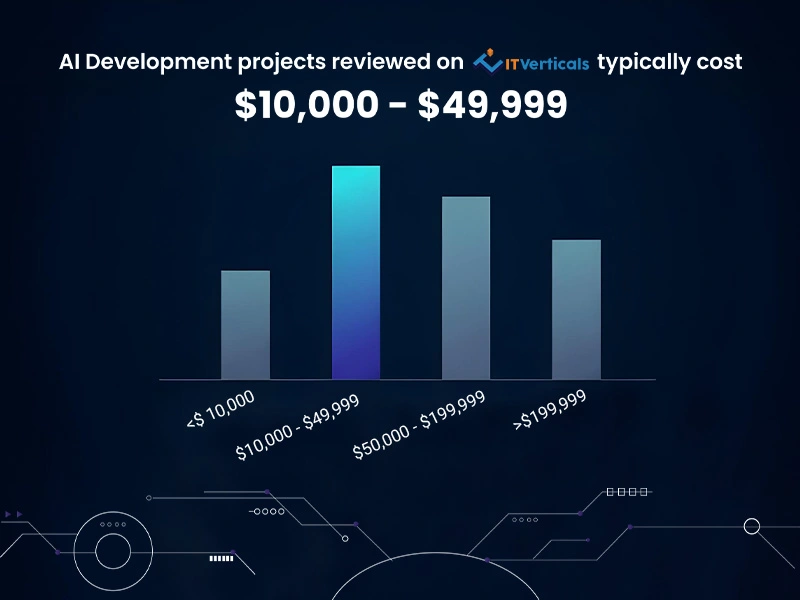
Not every AI project is the same. The AI development cost of a simple chatbot to respond to customer questions in real time will be much lower than that of an AI platform that is used to do sentiment analysis of millions of social media interactions or predict the trend of the stock market. The larger the scope and capabilities of your AI system, the more it costs.
As an example, chatbots based on AI usually cost between $10,000 and $50,000. These are natural language processing (NLP) capabilities, multi-language, and back-end integrations. In the meantime, machine learning platforms and deep learning solutions may cost up to and above half a million dollars, depending on the depth, real-time processing requirements, data modeling, and integration requirements. Each additional feature introduces complexity, which is equivalent to increased time and cost of development
The cost of training Gemini, which is a large language model that can be input with text, voice commands, and images, reportedly stood between $30 and $191 million even before taking staff salaries into consideration. These can make up 29 percent to 49 percent of the final price.
(Statista, 2024)

Key Factors That Influence the Cost of AI
The development of AI is not just a matter of the initial programming. Instead, it is the development of a smart, scalable system able to learn from large amounts of data, communicate with users or other systems in real-time, and continuously improve based on new data, behaviors, or market dynamics. In order to develop such an ecosystem, organizations need to consider a wide range of interrelated cost elements that affect the overall AI development cost over time.
There are a number of key drivers that work in the background and affect the AI development cost. These include the amount and complexity of data needed, the selection of infrastructure and frameworks, the skills of the team, and the number of AI use cases, as well as compliance and lifecycle management after deployment. Simply put, AI is not a plug-and-play solution; it needs careful planning and resources at each stage of development. Knowing these factors beforehand allows companies to make more realistic budgets and roadmaps and prevent cost overruns when scaling.
Data Preparation and Volume
Artificial intelligence lives on data, and not just any data, but high-quality, relevant, and well-labeled datasets. Your AI model can only perform as well as the quality and quantity of data it is trained on. It can be difficult and costly to source large amounts of data, particularly in niche markets such as healthcare, legal tech, or finance. Such industries frequently need domain-specific data that also has to be covered by data protection regulations such as HIPAA or GDPR.
Data preparation steps are:
- Gathering of data
- Cleaning and deduplication
- Supervised learning annotation and labeling
- Validation and check consistency
- Formatting of data according to the model requirements
Depending on the scope, hiring data engineers, domain experts, or third-party data annotation services can cost between $10,000 and $100,000 on top of your AI development cost. The expenditure may increase further in case of larger data sets because of storage, computation requirements, and compliance management.
Infrastructure and Technology Stack
The budget of your AI project can be broken down by your infrastructure choices. On-premise solutions involve a huge initial capital outlay in hardware (GPUs, servers, security systems), storage space, IT personnel, and software licenses. Also, on-prem installations require constant maintenance and scalability strategies, something that might not be suitable for businesses with variable workloads.
On the contrary, cloud services like Amazon Web Services (AWS), Google Cloud Platform (GCP), and Microsoft Azure provide flexible pay-as-you-go services that do not require an initial hardware investment. They offer ready-made solutions such as SageMaker, Vertex AI, or Azure ML, through which businesses can easily experiment, train, and deploy models.
In addition to infrastructure, the technology stack that you select is equally important. Open-source frameworks such as TensorFlow, PyTorch, and Hugging Face lower the costs of licensing but may require more in-house technical knowledge. Proprietary platforms are user-friendly and enterprise-ready, but can be subject to recurring fees and vendor lock-ins.
Other technical costs can also be:
- Container orchestration (e.g., Kubernetes, Docker)
- DevOps and CI/CD pipelines
- Compute resources GPU
- API integration and endpoint hosting
Selecting the appropriate mix of infrastructure and tools will not only make your AI development cost-effective but also future-proof in terms of iterative development and scaling.
How Much Does It Cost to Build an AI System?
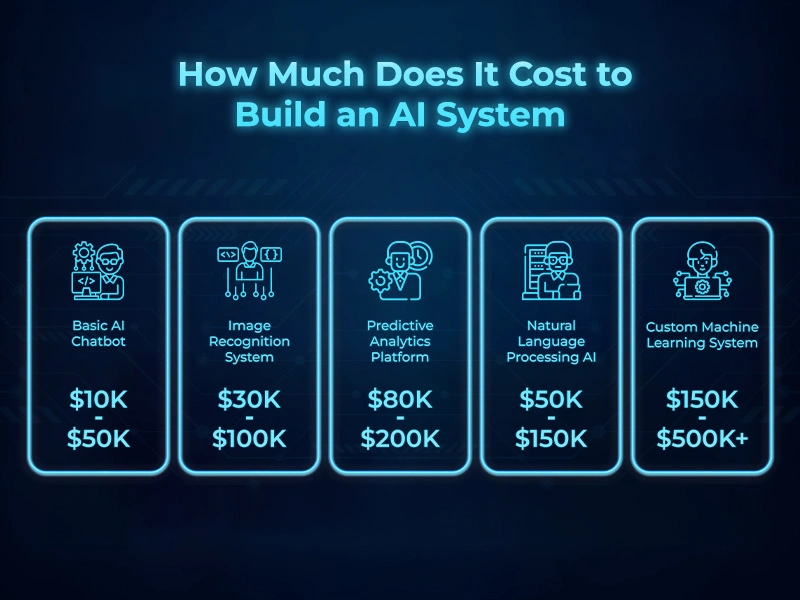
The following is an estimate of how much does it cost to build an AI system in terms of the type of systems. These numbers indicate low and high extremes to guide you to make realistic budgetary expectations.
| Project Type of AI | Cost Range Estimate (USD) |
| Basic AI Chatbot | 10,000 – 50,000 |
| Image Recognition System | 30,000 – 100,000 |
| Predictive Analytics Platform | 80,000 – 200,000 |
| Natural Language Processing AI | 50,000 – 150,000 |
| Custom Machine Learning System | $150,000 – $500,000 + |
The level of complexity of each solution has an effect on the schedule and budget. Whereas it may require a few weeks to develop a chatbot, a predictive maintenance or financial modeling AI system may require 6 to 12 months.
In addition, projects involving regulatory compliance (e.g., in healthcare or finance) will also be more expensive because of the necessity to add security and validation mechanisms.
Cost Analysis of AI App Development by Industry Sector
The AI development cost is also industry-specific. This is because the sensitivity of data, its regulation, functionality, and integration complexity differ across sectors. The following is a snapshot of average cost ranges by industry:
| Industry Sector | Estimated Cost of AI App Development (USD) |
| Medical | 100,000 – 300,000 |
| Finance & Banking | 80,000 – 250,000 |
| Retail & E-commerce | 40,000 – 120,000 |
| Logistics & Supply | 60,000 – 200,000 |
| Education & EdTech | 30,000 – 100,000 |
The total cost is increased in highly regulated industries such as healthcare and finance, where the cost of compliance (HIPAA, GDPR, etc.) and the need to be accurate and secure contribute to the overall cost. In the meantime, in such industries as retail or education, the emphasis is frequently placed on personalization, automation, or content suggestions that are usually less resource-consuming.

Artificial intelligence Cost Estimation Tips for Businesses
The cost of AI development is not only about receiving quotes from vendors; it is about strategic planning and operational transparency. A lot of companies underestimate the amount of work needed to do an AI project, particularly when they are new to the technology or do not have in-house AI expertise. This is why a good foundation with clear objectives and expectations is necessary.
Deloitte's reports, particularly their "State of Generative AI in the Enterprise" series, offer comprehensive insights into how businesses are approaching AI investment, what they're spending money on, and the challenges they face. 8 out of 10 organizations (78%) expect to increase their overall AI spending in the next fiscal year.
(Deloitte, 2025)
Begin by outlining your business objectives. Question: What are your particular issues you are trying to address with AI ? Do you want to automate a process, enhance customer service, or create predictive insights? A definite purpose will limit your focus and focus your team. Next, you should describe the key functions that you require, what systems the AI must interface with, and what quality and quantity of data you can use to train your models.
A feasibility study can be conducted to determine whether you will be able to meet your goals using available solutions or if you will need a custom build. Depending on the use case, it may be more economical and faster to deploy a prebuilt AI model or SaaS solution than to build one from scratch.
When approaching the vendors, do not accept a lump sum amount in account of AI app development cost. Ask to provide a breakdown of the costs, including all the stages of development, including research, data processing, model training, testing, deployment, and maintenance. Be careful of recurring expenses such as cloud services, retraining cycles, monitoring, and user support. The transparent quote will enable you to make an objective comparison of vendors and will not expose you to unpleasant budget surprises in the future development process.
Also, you should consider the internal expenses that your organization might have to deal with, including the recruitment of data scientists or training your existing IT team. By planning these factors, you will be able to create a more realistic AI budget and find stakeholder buy-in more readily.
Lastly, create flexibility in finances. Your needs might change as your AI system grows up, and so will the expenses. It can be new features, model retraining, or migration to new infrastructure, but adaptive budgeting helps your AI journey to stay on track and keep delivering ROI.
How to Reduce AI Development Cost?
It is not true that the cost of implementing AI has always been expensive. You can save a lot of money on development and not compromise performance with the proper tactics. Here’s how artificial intelligence cost estimation works:
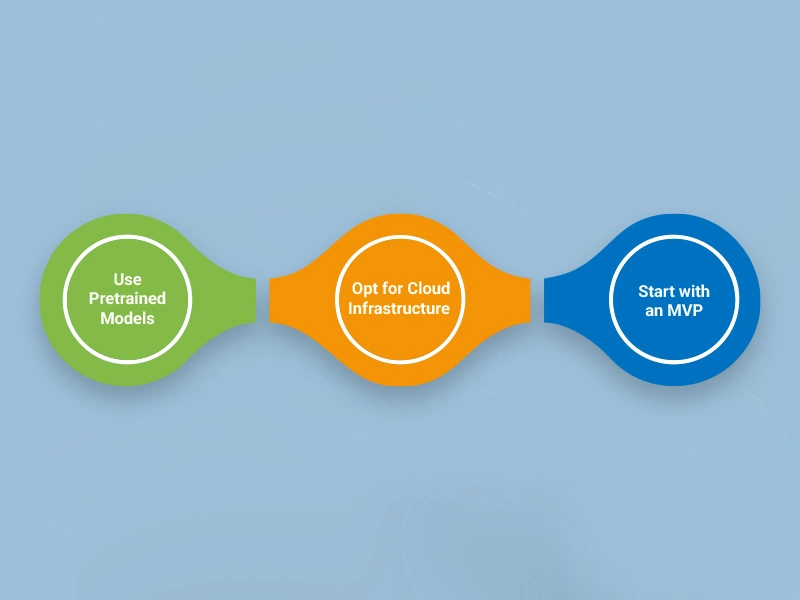
Using Models That Are Pre-trained
Rather than retrain a new model, use pre-trained models such as the OpenAI GPT, Google BERT, or Meta LLaMA. These models already know language, vision, or audio to some extent and just need to be fine-tuned to particular tasks, which saves time and reduces the cost of an Artificial intelligence based system.
Opting for Cloud Infrastructure System
Avoid expensive on-site equipment that increases AI software cost. Cloud infrastructure provides elasticity and cost-effectiveness, particularly in the case of large volumes of data. AI deployment can be simplified and overhead can be reduced by using services such as Amazon SageMaker, Google Vertex AI, and Azure ML.
Start with a Minimum Viable Product
Instead of releasing a fully-fledged AI product on day one, create a Minimum Viable Product (MVP). This initial version will just have basic features, which will assist in validating your idea and acquiring user feedback. It is low risk and does not invest a lot in features that users might not utilize.
FAQs: AI Development Cost
In addition to development, you will need to pay for cloud storage, API calls, licensing, compliance audits, retraining models, and supporting/updating your AI systems after launch.
AI is not a set-it-and-forget-it thing. Continuous investments must be made to retrain models, tune performance, update data, and scale infrastructure.
The factors that mostly affect the AI app development cost are the volume of data, the complexity of algorithms, the design of the user interface, compliance requirements, the depth of integration, and the requirement for real-time performance.
By prioritizing the need, the cost of implementing AI can be controlled by deploying cloud and open-source, outsourcing intelligently, and developing in increments rather than all at once.
Conclusion
The possibilities of AI in 2025 are limitless, but it requires planning and investment. Although the costs may be enormous, they are compensated by the efficiency, accuracy, and innovativeness of AI in businesses in the long run.
Be it a recommendation engine, a smart assistant, or an intelligent supply chain system, learning how much AI costs will help you to plan your budget and get the best return on investment.
ITVerticals Services

Email Marketing Strategy: Proven Ways to Improve Your Campaigns
Adam Romy
September 17, 2026

Digital Marketing Strategy: A Complete Guide to Online Growth
Samantha Leonie
September 15, 2026
Ecommerce Website Cost: Complete Guide to Pricing, Design, and Development
Adam Romy
September 10, 2026

Best Affiliate Marketing Platforms to Grow Your Business
Adam Romy
September 8, 2026
Link Building Pricing: A Complete Guide to Costs, Packages, and Services
Adam Romy
September 22, 2026
Email Marketing Strategy: Proven Ways to Improve Your Campaigns
Adam Romy
September 17, 2026
Digital Marketing Strategy: A Complete Guide to Online Growth
Samantha Leonie
September 15, 2026
Ecommerce Website Cost: Complete Guide to Pricing, Design, and Development
Adam Romy
September 10, 2026
Best Affiliate Marketing Platforms to Grow Your Business
Adam Romy
September 8, 2026
Revision History
Original Publication: Aug 20, 2025
Author: Adam Romy, Fact Checker: Samantha Leonie
Author

Adam Romy
Technology Content Author
Adam Romy is an author at IT Verticals, contributing to content covering technology and digital business topics. His work focuses on presenting information clearly and accurately for business readers. He helps make complex subjects easier to understand and apply.

Adam Romy
Author
Technology Content Author
Adam Romy is an author at IT Verticals, contributing to content covering technology and digital business topics. His work focuses on presenting information clearly and accurately for business readers. He helps make complex subjects easier to understand and apply.
Fact Checker

Samantha Leonie
Author & Fact Checker/Validator
Content Quality & Fact-Checking Specialist
Samantha Leonie is a fact-checker at IT Verticals, reviewing content for accuracy, clarity, and consistency before publication. She helps maintain the quality and reliability of published information.